آکادمی رابعی اخبار ، مقالات ،آثار و برنامه های مهندس حمید رابعی

نوشته های مشابه





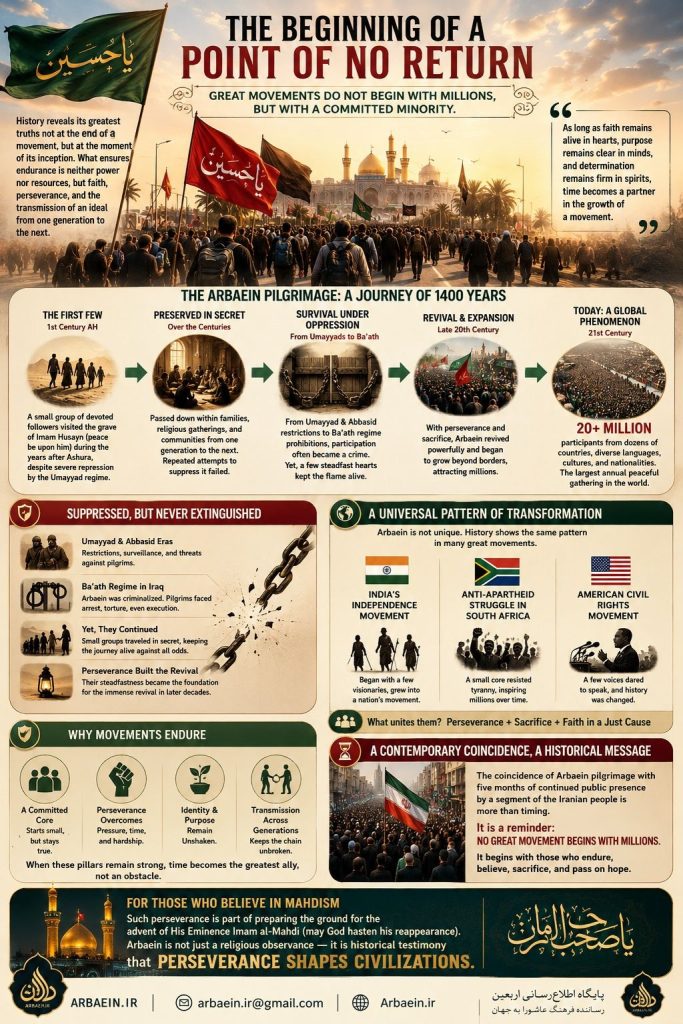
History sometimes reveals its greatest truths not at the end of a movement, but at the moment of its inception. Many of the movements that today unite millions of people began with only a handful of steadfast, faithful, and hopeful individuals. What ensured their endurance was neither visible power, abundant resources, nor large numbers at the outset. Rather, it was perseverance, faith, and the transmission of an ideal from one generation to the next.
For many observers, the coincidence of the Arbaein pilgrimage with nearly five months of continued street presence by a segment of the Iranian people recalls this very historical pattern—a pattern demonstrating that movements founded upon belief, identity, or collective demands, if sustained over time, possess the capacity to evolve from limited initiatives into enduring historical forces.
The Arbaein pilgrimage is a clear illustration of this reality. According to historical accounts, the first visitors to Arbaein were only a small group of devotees of the Prophet’s Household (Ahl al-Bayt), who, during the years immediately following the tragedy of Ashura, kept alive the memory of Imam Husayn (peace be upon him) despite the severe repression imposed by the Umayyad regime. At that time, no one could have imagined that this modest act would, fourteen centuries later, become the largest annual gathering in the world, bringing together tens of millions of participants from dozens of countries, representing diverse languages, cultures, and nationalities.
The secret behind Arbaein’s enduring legacy lies precisely here. This movement was not the product of a governmental campaign or a centralized organization. Rather, it expanded century after century through the continuous transmission of a deeply rooted belief within families, religious gatherings, successive generations, and grassroots social networks. Throughout history, repeated attempts were made to suppress this tradition. From the restrictions imposed by the Umayyad and Abbasid dynasties to the harsh prohibitions enforced by Iraq’s Ba’ath regime, none succeeded in extinguishing its flame. Even during the years when participation in the Arbaein pilgrimage was considered a criminal offense, a small number of devoted followers of Imam Husayn (peace be upon him) continued the journey in secret. It was precisely this perseverance that laid the foundation for its remarkable revival in later decades.
Social movement scholars argue that many transformative movements do not emerge through a sudden explosion in numbers, but rather through the resilience of their founding core. If that initial nucleus succeeds in preserving its identity, narrative, and ideals, more people will gradually be drawn to it. Arbaein stands as one of the clearest historical examples of this principle. What began as a small minority gradually evolved into a global identity without ever losing its connection to its original purpose.
From this perspective, one can observe a similarity in the pattern of growth between the Arbaein pilgrimage and many contemporary social movements. Both begin with limited participation. Both face pressure, sacrifice, and the erosive effects of time. Both endure only when their participants value perseverance over momentary enthusiasm. And both, if they successfully pass through this stage, have the potential to become part of a society’s collective memory and identity.
History offers many other examples that confirm the same truth. India’s independence movement, the struggle against apartheid in South Africa, and the American Civil Rights Movement did not begin with millions of participants. Rather, they started with relatively small groups willing to bear tremendous costs, and over time they attracted increasing numbers of supporters. What unites these experiences is a shared belief in the power of perseverance—the conviction that when time works together with collective determination, it can become a movement’s greatest asset.
Viewed from this perspective, the coincidence of the Arbaein pilgrimage with five months of continued public presence by a segment of the Iranian people is, for many observers, more than a mere chronological coincidence. It serves as a reminder of a recurring historical pattern: no enduring movement has ever begun with millions of participants. Great movements typically start with a committed minority willing to bear sacrifices, preserve hope, and pass their ideals on to future generations. As long as this chain of continuity remains unbroken, the passage of time does not weaken the movement; instead, it becomes its greatest source of strength.
Perhaps the most important lesson of Arbaein is precisely this: history is not always initiated by majorities. More often than not, it is a steadfast minority that, by preserving an ideal, opens a path that millions will follow centuries later.
From this perspective, many observers regard this coincidence not merely as a matter of timing, but as an indication of the beginning of a journey whose destination lies not in the present, but in the distant future. For those who believe in the doctrine of Mahdism, the continued perseverance of such a movement may be understood as part of the process of preparing the ground for the advent of His Eminence Imam al-Mahdi, the Awaited Savior (may God hasten his reappearance).
Historical experience consistently demonstrates that great ideas are not measured by the size of their beginnings, but by their capacity to endure, renew themselves, and inspire successive generations. As long as faith remains alive in people’s hearts, the purpose remains clear in their minds, and determination remains firm in their spirits, time ceases to be an obstacle. Instead, it becomes a partner in the construction, consolidation, and maturation of a movement.
Thus, the Arbaein pilgrimage is far more than a religious observance or an annual event. It stands as historical testimony to the fact that perseverance is the force that shapes great transformations. Movements that preserve their identity and remain faithful to their founding mission—no matter how modest their beginnings—possess the potential to grow into enduring civilizational phenomena whose influence transcends geographical boundaries and generations alike.
Hamid Rabei
Editor-in-Chief, Arbaein Website
Arbaein.ir